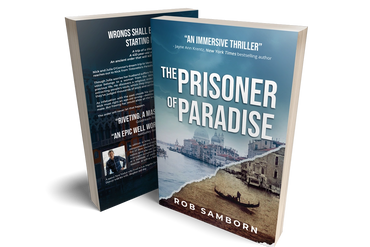
THE PRISONER OF PARADISE
THE EPIC HISTORICAL THRILLER
A trip of a lifetime.
A 433-year-old murder.
An ancient order that will kill to silence the truth.
FINALIST - AMERICAN WRITING AWARDS
FINALIST - AMERICAN BOOK FEST
SILVER MEDAL - HFC BOOK OF THE YEAR
Nick and Julia O'Connor's trip to Venice takes a dark turn when a voice calls out from Tintoretto's Paradise, a colossal painting that hides a sinister purpose.
Plunged into a labyrinth of intrigue and peril, Nick discovers an ancient religious order that wields the power to imprison souls within the artwork. For centuries, this order has doomed countless people to eternal purgatory.
Bound by an inexplicable connection to a woman from the past, Nick becomes consumed with a quest for justice. His mission: defeat the order, obliterate the priceless masterpiece, and liberate the wrongly imprisoned.
But the order controls more than the painting, with an ironclad grip on the city and secrets that could change the world—secrets they'll do anything to protect.
The lines between past and present blur, love clashes with duty, and the fate of souls hangs in precarious balance in this riveting dual-timeline thriller perfect for fans of Dan Brown, Daniel Silva, Diana Gabaldon, or James Rollins.
"...vivid narrative, world-building and edgy suspense is brilliantly showcased in this immersive, time-traveling thriller infused with Gothic horror, supernatural danger and twisty suspense." - Jayne Ann Krentz, New York Times best-selling author of the FOGG LAKE series, the LOST NIGHT FILES series, GUILD BOSS, and many more.
"The city of Venice soaks into your bones in Rob Samborn's The Prisoner of Paradise. As the painting comes alive, so does every word from the page in this gripping and transportive read." - EJ Mellow, bestselling author of SONG OF THE FOREVER RAINS and SCORCHED SKIES
"Wow! I picked this book because of the reviews, but even they didn't prepare me for the grandeur of the novel. ...an epic well worth reading."
- NetGalley Review
Print and e-books published by Lost Meridian Press. Audiobook published by Tantor Media.
This BOOK is intended for mature audiences only.
Listen to the Audiobook
Listen to the Audiobook
Listen to the Audiobook
Listen to the Audiobook
Listen to the Audiobook
Narrated by Zac Aleman. Available on all platforms.
Where to Buy (e-book and paperback)


Paperback & Hardcover (available at all stores - just ask!)




Going to Venice?
Make sure to visit the Palazzo Ducale (Doge's Palace), one of the main locations in the books. Stop by the gift shop, where you can purchase The Prisoner of Paradise, in the home of Tintoretto's Paradise!
Audiobook (available on all platforms)


Buy Local!
To find a local bookstore, click the link below.
If they don't have it in stock, please ask them to order it. They can get it!

Sample chapters from The prisoner of Paradise
1589 A.D.
Republic of Venice
“Were you followed?”
Angelo Mascari struggled to catch his breath, panting from his twenty-minute sprint through serpentine streets in oppressive summer humidity, not yet able to answer the tall nobleman glaring at him with steady, pale blue eyes.
Unfamiliar with this district of Venice, Angelo’s nerves demanded his senses be at full attention. They stood on the fondamenta of a narrow canal at a corner outside the Jewish Ghetto. No torches or lanterns lit the footbridge, the wall’s porticos, or a dozen other potential hiding spots on either side of the waterway. Silently, he thanked the moon for its fullness, as its light would provide precious seconds of reaction time should a lurker reveal himself. A black skiff bobbed next to them. Other than retreating the way he’d come, the boat was his only option for escape.
He was hesitant to trust the nobleman, but with friends in short supply and a warrant on his head, Angelo had little choice. That the man had yet to kill or arrest him was a promising sign. He slowed his breathing and leaned against the wall, the stucco’s mildew finer than wet velvet.
“You spoke the truth,” Angelo said between inhalations. “I should not have gone.” The heavy sea air left a salty tang on his lips.
“Were you followed?” his contact asked with a clipped whisper. Though the windows in the four-story buildings looming over them were shuttered, voices carried in the cramped neighborhood.
“No, impossible.” Angelo scanned the alley and glanced over his shoulder, more concerned with potential pursuers than prying ears. His words betrayed his confidence. No one was aware of his attendance at his beloved’s sentencing—but anything was possible.
I know that now.
His unnamed collaborator narrowed his eyes, seemingly reading Angelo’s doubt. Six or seven decades of lines etched themselves into the man’s face, framed by chin-length, oyster-gray hair. A snub nose lay in waiting over a trimmed beard of tarnished silver.
“Your childish endeavor accomplished nothing and nearly ended your life.”
Angelo did not appreciate this near-stranger chastising him, but he held his tongue. During their lone prior meeting, the man declined to disclose how he knew of Angelo’s predicament. He had also refused to divulge his identity, though his precise, modulated diction and distinct, upper-class air exposed his nobility.
“And you ruined your garments.” He scowled at Angelo’s lacerated hemp doublet and bloodstained white wool shirt, a stark contrast from the man’s all-black, posh attire. “That may pose a problem,” he said.
Angelo scratched at the squalid bandage that wrapped his left ear. Having neither bathed nor seen a mirror in many days, grime coated his bruised face and matted his curly, dark hair, but he cared not about his appearance.
The incredible sight he witnessed less than an hour earlier dominated his thoughts, though he’d yet to process it. He loathed to trust his eyes. From a concealed alcove in perhaps the largest room in Venice, he had watched, helpless. As his enemies concluded their ritual, it appeared as though they had drained Isabella’s very life essence from her body. In the flesh, yet flesh no more. The unimaginable agony she endured. His final vision of the once-beautiful girl, wilted and shackled, would be engraved in his brain for the remainder of his days, however few they may be.
He blamed himself for the whole of the affair. How could he not? Though only twenty, Angelo strove to live a virtuous life despite the widespread vice in his city. In the end, he succumbed to the greatest addiction of all—love.
Now, with no foreseeable way to rescue her, he felt no justification for standing unscathed. He should have been in her place. With his dreams quashed and his well-being an afterthought, he had two goals: avenge his beloved and—by some means yet known—save her from the torturous fate that befell her.
“Be truthful,” Angelo said, a humble demand. “What has become of Isabella? What? What did I witness?” He hung his head at the hopelessness.
“Mourn later. She’s not lost forever.”
A breeze skittered moonlight across the canal, bringing with it an acrid, fishy odor, though Angelo found it refreshing on his sweat-drenched skin. Hope swelled within.
From under his gold-embroidered, hip-length linen cloak, the nobleman removed a pouch of coins and a sealed letter, which he offered to Angelo. “Take these and this skiff. Make your way to Palos in Spain and find Sebastiano Cadamosto. Give him the letter. He’ll provide you passage to New Spain.”
“New Spain? What about our next move?”
“This is your next move. It’s your onlymove. At least for some time.”
“It’s the other side of the world.” Angelo abhorred the desperation in his voice, like a punished boy sent away when a man’s work had to be done.
“At present, you’re a liability to the Guild, to the cause at large. You’ll be caught here, anywhere in the Republic, perhaps anywhere in Europe. Go, posthaste. The ceremony has surely ended by now.”
Angelo eyed the boat. He had already been forced to flee danger twicein three days. The mere notion of abandoning Venice without so much as a goodbye to his friends and family grated his core. He’d never set foot on the mainland and was now told to traverse it. A most uncertain future lay beyond the horizon. How could he help Isabella from across the oceans, idling for years with a handful of ducats to his name?
“No,” Angelo said. “I cannot leave my home.”
“You should have considered that before seducing a married woman.”
Angelo seethed. “She’s the love of my life. Not some wanton mistress. I’ll join your cause and fight them here.” He grasped the rapier at his hip.
“Your prowess with the blade is well known.” The nobleman laid a gentle hand over Angelo’s and guided the sword into its sheath. “But how will you fare against a hundred men?”
“I shall die fighting.”
“Death is but the first consideration. And thenyour beloved will indeed be lost forever.”
Angelo conceded and released the hilt. He accepted the letter and coin purse, tucking them into his doublet. “To what purpose do you aid me? Answer that, I pray you.”
“Mutual adversaries. You may be the key to their demise. I’ll send word when it’s safe to return. When we can free Isabella and the others. Now go.”
With a reluctant nod, Angelo untied the small boat, then clasped his collaborator’s hand. “Thank you, sir. Tell me. How can I save her?”
“We need to—”
A whiz through the air was followed by the sickening thud of penetrated flesh and bone. The nobleman gazed at the blood pooling around the tip of the arrow jutting from his right shoulder, then at Angelo, with a mouth agape and befuddled eyes.
A second arrow embedded itself in his collaborator’s thigh. Cries of anguish slipped from the old man’s sagging lips. He dropped to his knees. The sight of yet another person’s blood inches away was too much for Angelo to bear. Like all Venetians, he was accustomed to injury and death, but never like what he’d witnessed recently. Never so sadistically.
“Go,” the man ordered, straining to utter the command. “You’ve seen what happens if they catch you alive.”
Angelo crouched and examined the arrow.
“There’s nothing you can do.”
Shifting to the wall, Angelo peeked around the corner. Two hulking men dressed in dark garb—one winding a crossbow, the other loading a bolt into his, stood thirty paces away.
“How? How can I save her?” Angelo asked in a whisper, crouching close to his collaborator. If he didn’t learn now, he’d likely never learn.
“Love of God, Mascari.” The man gripped Angelo’s collar. “What are you waiting for?”
Footsteps ambushed them.
Angelo squeezed the nobleman’s uninjured shoulder, then drew his rapier. “Wrongs shall be righted. Starting now.”
The attackers reached the corner. Both wore hoods obscuring much of their faces. A scar spread from the larger one’s eye to his mouth. The shorter of the two, though taller than Angelo, had an unruly brown beard.
“Run, you fool,” the nobleman shouted as he slunk into the canal, just below the bearded man’s swipe. The nobleman struggled to swim away, but the assailant caught his cloak and hauled him back onto the ledge.
The larger attacker charged. Angelo was ready. He lunged his rapier at the man’s crossbow, inducing an errant shot. The arrow ricocheted off the wall. In a flash, the man dropped the weapon, drew a short sword, and unleashed an assault. He pressed Angelo without remorse, driving the bout down the length of the narrow fondamenta.
The strikes were relentless and crushing, but the attacker’s shoddy technique exposed a weakness—his arm remained stiff, his wrist lacked rotation. Angelo parried the hacks, anticipating the right moment to riposte. It soon arrived. He angled for a side-cutting stroke, but an arrow flew through the flesh between his knuckles, cleaving a lump of skin from the back of his hand and spraying his arm with blood. The bearded assailant, while kneeing the nobleman to the ground, had shot with remarkable aim. Angelo gritted his teeth; his scorching right hand would be useless in this contest.
In one fluid motion, Angelo parried a wild swing from the attacker, tossed his rapier to his weaker left hand, and pivoted, dodging another blow. The switch drove his opponent off balance. His blade scraped the wall.
Angelo circled the man’s short sword with his rapier and squatted, completing his move with a slice through both thighs. The man dropped to his knees, writhing in agony. Angelo kicked his chin, then booted him into the canal.
Isabella was not yet lost.
He rushed to aid his collaborator but stopped short. From the alley, the commotion of an untold number of men, yelling and running toward him, reverberated off the adjacent walls.
At the corner, the nobleman’s eyes grew wide at the fast-approaching mob. “Go,” he screamed to Angelo with his remaining strength.
Death is but the first consideration. His collaborator’s words tolled in Angelo’s mind.
He spun, stomped on the scarred man’s fingers gripping the fondamenta edge, and raced for the skiff. An arrow zipped over Angelo’s head as his horsehide boots met the boat’s bottom, his impetus propelling the craft forward. He thrust the oars into the murky water.
Half a dozen men, all in black, rounded the corner. The first gave chase, dashing along the canal edge. Angelo paddled with all his strength, an excruciating task with a mangled hand.
At the canal’s edge, the pursuer tossed his empty crossbow on the cobblestones and dove for the boat. He caught the gunwale, nearly capsizing it.
“The Order will take you,” he cried as he climbed in.
Angelo yanked an oar from its rowlock and swung it into the attacker’s cheek, knocking the man into the water. Resuming his frantic paddling, he glimpsed the far end of the fondamenta. As the bearded assailant pressed the nobleman to the ground, the old man stretched for his boot, retrieved a dagger… and slid the blade across his own throat.
Stunned, Angelo rested an oar to cross himself.
An arrow struck the skiff. Another flew past from his ear. As more arrows landed in the water, Angelo hunkered and rowed furiously to the wider Rio di San Girolamo canal, which led to the open waters of the Venetian Lagoon.
Guilt roared through him—his collaborator’s death was on his hands. A vision of Isabella flashed in his mind. 'Mòre mio. I failed you.
One day, he vowed. One day, her captors will feel a pain far more severe.
I
Present Day
Salvatore della Porta slid his rectangular Gucci eyeglasses higher up the bridge of his Roman nose and allowed the irritated voice on the other end of the phone to ramble on. The Commissioner of the Venice Biennale had been complaining for five minutes without a single pause. Della Porta combed his fingers through his salt-and-pepper hair, parted to the side and brushed back with the slightest amount of hair tonic. Though not a classically handsome man, he was keenly aware that looks could be improved with an appropriate fashion sense and proper grooming techniques.
“You and your pathetic hubris probably cut attendance in half,” the Commissioner screamed into della Porta’s ear. The man’s Italian was flawless, but his Swiss accent and heavy-handed cadence made him sound like a dubbed version of a dopey cartoon dog.
“It has nothing to do with hubris, signore,” della Porta said in Italian, maintaining an even keel.
“Then what? Enlighten me.”
“With all due respect, you may’ve been a bigwig in Basel, but you’re unfamiliar with certain sensitivities here in Venice.”
The braggadocio continued to berate him for declining an interview with the London Times’s art critic, but his voice trailed off to a place that hovered behind della Porta’s ears. Switching the call to speakerphone, della Porta stepped over to a bookshelf where rows of long-cherished manuscripts made their home. He traced his finger through a layer of dust on the shelf and made a mental note to reprimand the cleaning crew.
This office was his home and, in this case, truly a palace. He glanced about the spacious room, bedecked with early baroque-era furniture, 19th-century seascapes, and a collection of antique telescopes, sextants, and compasses that would make historians dizzy with glee. Of course, one would expect nothing less in the office of the Director of the famed Musei Civici di Venezia, an august foundation of eleven museums in Venice. His workspace was the beating heart of the Palazzo Ducale, or Doge’s Palace—the foundation’s touristic highlight and cultural crowning star.
Della Porta turned his attention out the window to the Venetian Lagoon. Hundreds of vessels of all sizes entered or departed the city in a fluid tapestry.
This used to be the seat of government for the wealthiest maritime power in the world, he thought. Now it’s a museum for tourists.
He sneered at a cruise ship. Needing to take control of this conversation, della Porta sat at his desk and picked up the phone’s receiver.
“We have nothing to hide, but that’s not the point,” he said. “Lionel Benton may be a prominent art critic, but he also loves shining the spotlight on himself with his outrageous conspiracy theories. Every two years he attempts to damage my reputation or the Palazzo’s with accusatorial nonsense that could tear down everything we built.”
The Commissioner’s rant rose in volume as he continued.
Della Porta suppressed a sigh and shut his gray eyes for a moment. At times, many times, he could not believe he held this position. He wasn’t a man to dwell on the past, but would his authority be questioned so frequently had he come from more prestigious means? Raised modestly in a coastal suburb outside of Venice, he developed an early appreciation for the arts on his first school trip to the city and learned his business acumen in his teens, when he ran his father’s apparel company in the summer months. His four younger siblings didn’t inherit the ambition gene and inexplicably still lived in Chioggia. Though only fifty minutes away, he limited visits to two or three times per year, either for Christmas or to dine at his brother’s trattoria, which della Porta had bailed out financially some years back.
In comparison to those whose shoulders he now brushed, his middle-class upbringing left him somewhat unrefined—a half step above his family and schoolmates, yet a half step out of his current circles. In situations like these, insecurities revealed themselves with less than professional manners.
“I don’t care if his review castigates the Biennale and exposes the trash you think passes for art,” della Porta cut in. “If you don’t like my decision, take it up with the mayor.” He slammed the phone down with a clenched hand.
The skirmish would have ramifications, but della Porta reassured himself he acted with reason. He wouldn’t let an outsider jeopardize all that he wanted—no, needed—to accomplish. He’d worked too hard professionally and sacrificed too much personally to reach this point, even leaving his fiancée twenty years earlier to focus on his career. He hadn’t dated since and had no regrets. As a priest is married to the Church, della Porta was married to the art of his museums—eternal art that transcended the mundane.
His anger toward the Commissioner and the man’s fugacious taste gave him a jolt of unexpected energy. Della Porta raised his slight frame from behind the ornately chiseled desk and smoothed his custom charcoal gray wool suit before shutting down his computer and pocketing his smartphone.
As it was after hours and the Palazzo was devoid of visitors, he strolled the expansive hallways, passing through rooms that were time capsules of Venice’s heyday, and entered the Great Council Room, his footsteps echoing in the chamber. Still the city’s largest room, it had once been the assembly hall for the Senators of the Republic, and their impassioned ghosts empowered him.
He groped the ever-present pendant hanging from his neck beneath his shirt.
The room’s air tasted of history, of centuries-old incense. The heaviness scuttled past his tongue to the far reaches of his lungs and calmed his pulse.
Della Porta sat on one of the permanent red oak benches encircling the room. With the walls and ceiling covered in masterworks depicting Venetian history by Veronese, Tintoretto, Palma the Younger, and other Renaissance masters, the space never ceased to inspire him.
Tintoretto’s Paradise spanned the entire main wall. A somber yet groundbreaking work, the painting depicted Jesus coronating Mary as Queen of Heaven, enveloped by hundreds of adoring souls. Lining the top of the three other walls were portraits of the seventy-six doges, the dukes who governed the Republic for eleven hundred years.
Della Porta gazed meekly at the artwork. All the people in the paintings seemed to mock him: You’re not the right man for the enormity of the task at hand.
The rear wall held the portrait of Doge Marino Faliero, though a black shroud had been painted over his face to commemorate his brief rule. Della Porta had memorized the story at an early age. The traitorous duke was decapitated after an unsuccessful coup d’état. Faliero not only lost his head, but the people mutilated his body and burned many records of his existence.
A chill bristled della Porta’s skin. He shook it off. Where the duke failed, he would not. This was his time for ascension, for reviving past glory.
Composing himself with three quick exhalations, he strode toward Paradise.
“Remember who you are,” he whispered.
When he arrived at the wall, he crouched, reached under a seat, and twisted the lever that unlocked the hidden door.
II
Fuck, that hurts.
Nick O’Connor couldn’t recall getting hit in the back of the head with a baseball bat, but it was the only explanation he could muster in his hazy state. A thick cloud capped the collateral pain streaming to his frontal lobe. He moistened his lips and shifted, mentally scanning his body for additional signs of trauma. His lower back ached, and his quadriceps screamed, but they were nothing compared to his head.
A distinct, sterile odor mixed with the stench of dried blood wafted into his nostrils. A steady dripping floated into his ears like drops of water hitting an empty metal pan.
“Doctor, he’s waking up.”
A young woman’s voice hovering over him sounded anxious, but the allure of her tone coaxed his mouth into an involuntary smile. Soft hands clasped his, comforting him. He knew that voice and touch, perhaps intimately, but the throbbing in his skull prevented him from placing their owner.
Footsteps rushed near. “Excuse me, Mrs. O’Connor,” another woman said with a rough, battle-weary voice.
Upon hearing, ‘Mrs. O’Connor,’ Nick smiled. The young voice and touch belonged to his wife, Julia. His contentment dissolved to dismay. Even without seeing her, he should’ve been able to recognize the love of his life.
Julia’s fingertips lingered, connected to him a second longer before releasing her grip. “He’s gonna be okay, right?”
Nobody answered.
A cold palm rested on Nick’s forehead. A finger lifted his eyelid. Intense light cut through the dark, flooding his vision.
Nick recoiled and swatted the hand away.
“Let the doctor do her job, Nick,” said a male voice he recognized instantly. It belonged to Wade, his older brother.
The light invaded his space, and again, Nick shoved it off.
He opened his eyes completely to find an auburn-haired woman in her sixties wearing glasses and a doctor’s coat. She gripped a penlight between claret-red fingernails. Next to her stood Wade, a few days shy of his thirtieth birthday. He wore an amateur hockey jersey, and his wavy brown hair had the marked look of sweaty helmet-head.
“I’m fine,” Nick said, his hoarse words clawing over parched vocal cords. “I just wanna know what happened.”
Fuck, my head hurts. He didn’t have a clue as to why he outright lied to a physician. He was far from fine.
Julia watched behind Wade, her hand pressed to her mouth. Nick gazed beyond his brother and smiled warmly at her. The bronze specks in her emerald eyes shimmered beneath the harsh, fluorescent ceiling fixtures. Typically, one glance at any inch of his wife was a cure-all, but admiring her now offered little consolation. Never had his brain experienced such an acute beating or disorientation. Determined to get his bearings, he assessed his surroundings further. He lay on a narrow bed with crisp white sheets in a small room. He attempted to raise his hands but felt his arms chained to the bed.
Alarmed, he lifted his head. He only glimpsed the same amateur hockey jersey on his torso before an invisible mallet whacked his cranium back onto the pillow.
“What’s the last thing you remember?” the doctor asked.
“Why am I in a hospital?” Nick winced. Every word was like a piledriver pendulating from ear to ear.
The doctor tucked the penlight back in her pocket. “You’re at Mass General. You were body-checked, and your helmet came off. Your head hit the ice.”
Snippets of a hockey game trickled into Nick’s memory. Rushing the goal… the clock ticking down… readying his stick for the shot… nothing.
“Out cold for thirty-three minutes,” his brother added. “In and out of consciousness for another hundred and forty-four.”
“But why am I chained to this bed?” Nick asked, still unable to move his arms.
In unison, Julia and Wade furrowed their brows and turned to the physician for an answer.
“That’s the morphine talking,” she said. Lifting Nick’s left arm, she showed him an IV needle stuck in his vein. The dripping sound evaporated, replaced by the steady beeping of an EKG machine.
Nick sighed, though a part of him wished he was healthy and under arrest for some mysterious crime.
Julia squeezed past Wade to Nick’s side. She took his hand again and kissed it. Nick gasped at the marble-size, spherical diamond on her engagement ring. “I was so scared,” she said. “Seeing you laying there… You haven’t even touched that. Hello …? Nick—?”
~
Nick O’Connor woke with a start.
Beads of sweat rolled down his back.
“You okay, babe?” Julia placed her iPad on the table, staring at him with a grave look of concern.
He blinked and glanced around. The sights, smells, and sounds of his present location blitzed his brain like a tsunami flooding his subconscious. They were in Venice, on a side of St. Mark’s Square, sitting at a round, white linen-covered two-top table outside of Caffè Lavena. A paid bill and an untouched cup of espresso sat in front of him. Julia’s empty cappuccino mug sat next to her iPad.
“Yeah, yeah. I’m fine,” he muttered.
Exhaling, Nick felt more mystified than relieved. The memory was so lifelike, yet it faded as he checked out the throng of international tourists parading through the plaza, large enough to hold three football fields and lined with hundreds of arched windows set above an arcade of overpriced restaurants and gift shops on the ground level. Two young boys raced past their table flapping their arms, scattering a flock of pigeons into the air. A tour group followed, led by a college-aged woman wielding a yellow umbrella like a marching baton. The three dozen other tables at their café were occupied with the same thing as theirs: tourists eating an overpriced breakfast, looking at their phones, or people-watching.
Though the sky was overcast, the dawn’s rain had left a sheen on the geometrically-patterned stone floor, so he shielded the glare battering his sleep-deprived eyes.
“You look like you hit a wall,” his wife said. “You gonna drink that or what?” She pointed to his espresso. Gone was the sphere on her ring, replaced by the one-carat, princess-cut diamond he bought her nearly five years ago.
“Sorry, I… got lost in the moment a sec. I’m just jet-lagged.”
Frowning, she turned her gaze across the vibrant square.
Nick took a sip of his coffee and caressed the gash on the back of his still-sore head, a most unwanted trophy from the hockey game. He wished he’d worn a hat to cover the stitches.
It had been two weeks since the accident. Well, not an accident. He still resented the opposing player in his community league who decided a blind cross-check was a shrewd tactic. He’d recollected everything by the following day. Amazingly, it wasn’t the hit or the pain he couldn’t shake, but that image of Julia and Wade gaping down at him in the hospital.
He felt terrible being such an inconvenience to everyone. Even the rink janitor had complained about the amount of blood. But what really ground Nick’s gears was his doctor prohibiting him from playing when the game resumed a few days later. He’d led the Boston Pilgrims to three city championships in a row and was pissed to hell he had to watch this final from the bench. They lost.
Nick sighed. What’s another year?
Julia eyed him feeling his head wound. “Does it still hurt?”
“Nah, solid as a rock.” He knocked on his skull, aggravating the discomfort.
Though he hated all the attention over a stupid injury, Julia’s compassion never failed to imbue warmth in his soul. She was his rock and his heart. They were both only twenty-eight, but he never once questioned his decision to tie the knot young. Her sunny outlook, profound intelligence, and genuine empathy for all living creatures added up to a marriage their single friends envied.
He didn’t blame her for still worrying about his injury, but other than a wicked headache and the occasional mind-wander, he felt fine. Or, at least, that’s what he told the doctor. And his wife. The doc cleared him for the trip, though Julia had wanted to cancel the entire thing. Nick had none of it. Even if he had severed a limb, he’d take her to Venice and help her realize her dream.
He threw her a smile that stretched into an irrepressible yawn. She smiled back and returned her attention to her iPad.
Not yet adjusted to the time change, Nick woke before dawn in their room at the Bauer Hotel, a beautiful five-star, where Julia had managed to find an unbeatable last-minute rate. Realizing she was also awake, without a word, their spooning segued to a lazy lovemaking session, a departure from their typically vivacious sex. Although he could’ve stayed in the king-size bed with her forever, she reveled in the early start. With one more free day until she needed to work, she had a full itinerary of sightseeing planned.
After checking in the previous evening, they explored a small slice of the maze-like city and ate dinner at a quaint restaurant near their hotel, which Nick surmised served the best mussels in Italy, if not the universe. Venice’s food and scenery had already blown him away, but later he realized that on the walk back, he had criticized the city’s government for permitting motorboats in the canals. It wasn’t how he’d imagined their first night out. An unexplained funk had rolled into Nick’s head like a New England fog, and dispelling it proved to be difficult.
He despised his current mindset and had been trying to return to his old self all morning. His wife, on the other hand, exuded full vacation mode, despite the fast-approaching, most important meeting of her career. Reclining a bit, she crossed her legs, her tight white jeans getting even snugger. He loved her rocking yoga body, but in the moment envied her comfort level. Nick regretted choosing dark blue Levi’s over shorts. The Mediterranean humidity made the denim stick to his thighs, and his most cherished article of clothing, a wide black and brown leather belt with a matte chrome buckle Julia had bought him two birthdays ago, suffocated his body.
Loosening his belt a notch, he inhaled the woody and roasted citrus notes of the espresso. He swigged a shot, swished the deliciousness around his mouth, swallowed, and shook his head to disperse the caffeine. More awake, he reflexively grabbed his cell to check his social media accounts and political news, but curiously felt zero desire to do so—which he didn’t mind. He’d been trying to kick the masochistic addiction for two years. Going cold turkey wasn’t in the cards, but perhaps this trip would be the diversion he needed. Pocketing his phone, he leaned across the table to view Julia’s iPad.
The screen displayed a dinner party from a seemingly impossible perspective of multiple angles from the ceiling corner, stitched together in a mosaic. Stark walls dominated the shot, and the people were saturated in vivid color. The photo showed much of the dining room yet offered no indication of who held the camera, giving the surreal impression of a spider’s eight eyes observing the routine event of humans eating dinner. The upper-left of the screen showed the logo for the Venice Biennale Art Exhibition.
“There’s too much red,” Julia said, perturbed. She pulled her shoulder-length, honey blonde hair into a ponytail, wrapping it with a hairband from her wrist.
“Right. That’s what the judges were thinking. That gallery in New York, too. Come on, Jules, it’s literally an award-winner.” Beneath the table, Nick gave her a playful nudge, an attempt to convince her—or himself—he’d returned to normal. “When’s your meeting again?”
“Tomorrow at two.” She picked up the tablet and opened the email app. “Speaking of which, I finally heard from Delta’s inflight magazine.”
“You’re a rock star, babe. So that means a fully expensed trip? Tuscan steaks every night from here on out?”
“Hilarious. They agreed to look at the article. I haven’t even written it yet.”
“Still great news. It’ll be awesome, and they’ll run it. What about the others?”
“Nothing yet. Anyway, point is, I’ll need another three hours or so at the Biennale to interview some people. There’s lots you can do. The art’s gonna be amazing, or I read there are beautiful gardens there, or you can take a tour, or there are boat—”
“Babe, babe, I’ll find something to do. Venice was always your trip. I’m just along for the ride. And the pasta. And the wine. Actually, that’s not a bad idea. I’ll find a bar and wait it out. Mingle with the locals.”
Chuckling, she rolled her eyes, knowing he was half-serious.
Sure, the sights or a boat tour would be cool, but they wouldn’t be the same without Julia. Nick meant every word about it being her trip. After her photo took first place in the Biennale’s amateur entry competition, he used his banked PTO and booked a three-week vacation, including four days in Venice. The cost exceeded their budget, but the joy on his wife’s face was worth every penny.
A New York gallery owner had reached out to meet her at the exhibition, so the trip was already paying off for her career. The Delta article was gravy. He didn’t care he brought in 90% of their income as a fintech software architect. Julia’s freelance journalism helped pay for some stuff, but Nick cared far more about her real passion—photography. With her talent, it was only a matter of time before she hit a home run.
Nick downed his remaining espresso and turned to her. “Hey, what do you call people in Venice who can’t see?”
“What?”
“Venetian blinds.”
“Is that supposed to be funny?”
“Not even a little bit.” Nick stood. “Come on, let’s go see some sights.”
“Now you’re talking,” Julia said, tucking her iPad into her leather purse that doubled as a camera bag. She pulled out her DSLR and rose.
He reached into his pocket and dropped a few euros on the table.
“You don’t need to tip here,” Julia said.
“It’s not gonna bankrupt us.” Nick knew his habit of tipping generously annoyed her. He appreciated her concern since they only had one full-time salary, but he wished she’d trust him with their finances. It was the one thing about her that bothered him. Well, maybe not the one, but the list is damn short. They both let it go and joined the teeming masses in the square.
He scowled at the tourists. “Is it wrong to wish we came here during Covid? Remember all those pics of deserted squares? Dolphins in the canals?”
Julia widened her eyes. “Beyond morbid. Painful too.”
“Sorry.”
“I love that everything is back to normal”—she sidestepped a woman hauling six shopping bags—“but I get your point. I pity the locals. How many plagues has Venice lived through?”
Nick shivered. Her question struck an odd, personal chord. He intertwined her silky fingers with his. “At least we’re finally in Europe together. Eight years later…”
“Eight? Wait, are you still beating yourself up over that?” she asked, picking up on his tone of regret.
“Missing out on a week in Paris with my girlfriend? Yeah.”
“And miss a week of the season?”
“Collegeseason. And it’s not like I got drafted.”
Julia motioned to Nick’s head. “Can’t say I’m too upset about that.”
He knitted his brow. “Either way, I should’ve visited you.”
“Honey, it’s the now that matters. And the future.” She kissed his hand. “We have the rest of our lives to travel. Including this trip, which is already epic, and I can’t thank you enough for it.”
He prayed she was being sincere. Like an answer from above, sunrays penetrated the thick cloud layer.
“I don’t know why I’ve been so salty since we got here,” he said, “but I promise I’ll turn it around. Prepare yourself for the happiest tourist Venice has ever seen. Hey, get a shot of me with the tower in the background.” He ran a few feet and brandished two thumbs up, his double-wide grin making Julia laugh.
She positioned herself to get the best angle, crouched, and raised the camera. “The light’s perfect right now,” she said. “Love those dark eyes and gorgeous smile. This might be the next cover of Hot Husbands Magazine.”
Nick replied by turning around and wiggling his butt.
With his back to Julia, he glanced up at St. Mark’s Campanile, which he’d read about on their flight. The thirty-two-story brick bell tower reached for the sky and was adorned with a giant pyramidal cap. Directly below the pyramid, a six-foot-tall, gravity-defying stone chimera sculpture soared over the city. Saint Mark’s winged lion was the ubiquitous symbol of Venice, its image gracing everything from doors and tiles to umbrellas and bags of souvenir pasta.
As the lion flapped its wings and took flight, the ground shifted beneath Nick.
The monster swiveled its face toward him, exposing a row of sharp teeth. The piazza slanted, and the tower elongated. His equilibrium slipped. The chimera banked and flew away, aiming for a crack in the clouds.
The bustling sounds of the square vanished. Blood pounded his eardrums. Faint church bells rang. Distraught women cried in the distance.
“Turn around,” Julia called.
His heart rate quickened. His breath popped in short spurts.
He turned back to his wife. Her green eyes morphed to brown, and her fair skin took on a more olive, glowing complexion. Nick offered a weary grin, unsure of what was real in the moment.
Keep it together, buddy. Don’t ruin this for her.
Julia snapped the picture and hung the camera strap across her chest before walking over.
Relief washed over him as he realized she hadn’t noticed the episode. His heart resumed its normal pulse, and the clamminess encompassing him dissipated.
“Ready?” She linked her arm through his.
Her touch calmed him back to reality and hopefully… normality.
He cleared his throat. “For what?”
“The Palazzo.”
“The whatzo?”
“Babe, it’s right there. I told you at the café.”
She pointed to a large, elaborate building fifty yards away. “The Palazzo Ducale. I’m dying to see it.”
“Impressive,” Nick said, perking his eyebrows as he turned to look. Every square inch of the four-story peaches-and-cream-colored façade was ornamented with statues, columns, capitals, arches, and tiles.
The Palazzo was situated on the edge of St. Mark’s Square, at the corner of the Riva degli Schiavoni, the wide waterfront promenade along the Grand Canal. The river-size canal was the biggest in Venice—a major water thoroughfare winding through the city from end to end.
Nick inhaled through his nose. Though he lived in a coastal city, the air here seemed more… settled.
“What is it again?” he asked.
Julia flashed him a look as if he’d said the most unreasonable thing she’d ever heard.
“I was listening to you, babe. I don’t know. The caffeine hasn’t kicked in yet. Tell me again.”
She groaned but pulled out her iPad.
“Though it shares a wall with St. Mark’s Basilica,” she read aloud from the TripAdvisor app, “the Palazzo Ducale’s design casts a mismatched juxtaposition with the mushrooming onion-bulb architecture of the cathedral. Since 1923, the imposing Venetian Gothic landmark has been a museum, housing hundreds of the world’s most important Renaissance artworks. Built, damaged, and rebuilt since the twelfth century, the compound encompasses a mix of architectural styles.” She smiled at the building. “It’s the Doge’s Palace.”
“What’s a doge?”
“A duke. They were the leaders of the ‘Most Serene Republic of Venice’ for over a thousand years. It’s a top sight in Venice.”
“It does look like it’s calling our name. Or… we could use the gray weather as an excuse to cozy up with a bottle of wine in our room.”
“Come on. We’re seeing it now,” she said, clearly peeved Nick was trying to weasel his way out of something on her must-do list. “We’ll have wine tonight.”
“All night?” he asked with a smirk, pulling her body into his.
She kissed him. “Can you think of a better use for jet lag?”
“I like it.”
Julia pulled away and tucked the iPad into her bag. “I know you do. And I promise you’ll love this place. It’s the kind of art that’ll change your life. See you there.”
Before he replied, Julia made a mad dash toward the Palazzo. He gave his wife a few more seconds, then took off, slapping her butt as he ran past.
For a moment, he could’ve sworn soft strands of auburn hair brushed across his face. Hair that smelled of cinnamon and rose. Hair that smelled… familiar.
This website uses cookies.
We use cookies to analyze website traffic and optimize your website experience. By accepting our use of cookies, your data will be aggregated with all other user data.
